

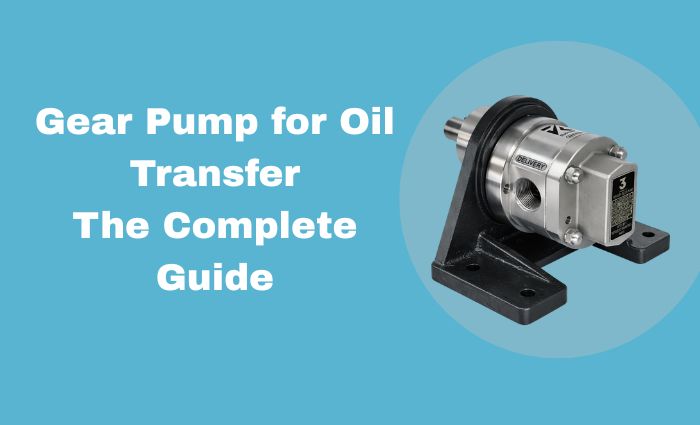
What Is a Gear Pump for Oil Transfer?
A rotary gear pump for oil transfer is a positive displacement pump that uses interlocking gears to move oil — or other viscous fluids — from one place to another at a consistent, metered flow rate. Unlike centrifugal pumps that rely on kinetic energy, rotary gear pumps trap a fixed volume of fluid between rotating gear teeth and the pump casing, then push it toward the outlet on every revolution.
This makes them one of the most reliable technologies for industrial oil handling. Whether you’re circulating lubricating oil in a turbine, transferring crude oil at a refinery, or metering hydraulic fluid in heavy machinery, a properly selected gear pump delivers the stable performance that modern operations demand.
Key Insight
Gear pumps are classified as rotary positive displacement pumps. They deliver a fixed volume per shaft rotation, which means flow rate is directly proportional to speed — making them excellent for precision metering and dosing applications.
How a Gear Pump Works
Understanding the operating principle helps you use and troubleshoot these pumps effectively.
Suction (Vacuum Creation)
As the drive gear rotates and the teeth unmesh on the inlet side, a low-pressure zone (partial vacuum) forms. This draws oil from the reservoir into the pump inlet.
Fluid Entrapment
Oil is captured in the spaces between the gear teeth and the pump housing. The gears carry this trapped fluid around the outer periphery of the pump chamber — it does not flow between the meshing gears.
Discharge (Pressure)
On the outlet side, the gear teeth re-mesh, squeezing the oil out of the cavities and forcing it at pressure into the discharge line. The result is a steady, near-pulsation-free flow.
Self-Priming
The rotating gears can evacuate air from the suction line and draw oil in without manual priming — a major operational advantage in systems where suction conditions vary.
Types of Gear Pumps: Internal vs External
The two primary configurations — external gear pumps and internal gear pumps — suit different oil transfer scenarios. Choosing between them is one of the most important decisions in pump selection.
External Gear Pumps
External gear pumps use two identical spur gears with externally-cut teeth that mesh together inside a tight-fitting housing. One gear is driven by the motor; the other follows. They are the workhorse of hydraulic power systems and fuel oil transfer.
- Handle pressures up to 3,000–3,500 psi (210–250 bar), with high-pressure variants exceeding 4,000 psi
- Operate at high speeds of 1,500–3,000 RPM with volumetric efficiency often above 90%
- Best suited for hydraulic oils in the ISO VG 32–68 viscosity range (5–1,500 cSt)
- Simple, robust design with four bearings — easy to maintain and repair
- Available with spur, helical, or herringbone gears (helical/herringbone = quieter, smoother flow)
- Typically less expensive than internal gear pumps
Watch Out
External gear pumps are inherently louder than internal types. The high-speed meshing of spur gears creates a high-frequency whine. For noise-sensitive installations, choose helical gears or an internal gear pump design.
Internal Gear Pumps
Internal gear pumps operate on a “gear-within-a-gear” principle. A smaller external rotor meshes inside a larger internal ring gear. A stationary crescent-shaped partition separates the suction and discharge zones. They are the preferred choice for heavy oil transfer, chemical dosing, and high-viscosity applications.
- Handle extremely viscous fluids from 30 cSt up to 60,000 cSt — ideal for heavy oils, bitumen, molasses, resins
- Quieter and smoother flow than external types due to continuous gear meshing
- Bi-directional capability (with spur gears) enables filling and emptying from the same pump
- Better suction characteristics — can handle higher suction lifts
- Only two bearings, giving a more compact form factor
- Can be jacketed externally to maintain fluid temperature for waxes and thermal oils
Side-by-Side Comparison
| Parameter | External Gear Pump | Internal Gear Pump |
|---|---|---|
| Max Pressure | Up to 4,000+ psi (280 bar) | Moderate — typically up to 1,500 psi |
| Viscosity Range | 5 – 1,500 cSt (diesel, lube oil, hydraulic oil) | 30 – 60,000 cSt (heavy oils, bitumen, polymers) |
| Operating Speed | High (1,500–3,000 RPM) | Lower, gentler on shear-sensitive fluids |
| Noise Level | Higher (especially with spur gears) | Quieter, less pulsation |
| Flow Direction | Uni-directional (spur can be bi-directional) | Bi-directional (spur type) |
| Cost | Lower — simpler to manufacture | Higher — more complex design |
| Maintenance | Moderate (4 bearings) | Easier (2 bearings) |
| Best For | Hydraulics, fuel transfer, machine lubrication | Heavy oils, bitumen, resins, food-grade oils |
| Self-Priming | YES | YES (better suction) |
| Dry-Run Damage | YES — avoid | YES — avoid |
Key Benefits of Using a Gear Pump for Oil Transfer
1. Consistent, Pulse-Free Flow
Because CI gear pumps are positive displacement devices, they deliver a fixed volume of oil per revolution regardless of discharge pressure (within design limits). This gives operators predictable, metered flow that is essential for lubrication circuits, dosing, and precision process control.
2. Excellent High-Viscosity Performance
Gear pumps excel where centrifugal pumps fail — at high viscosities. The positive displacement action efficiently moves thick oils, lubricants, and even semi-solid materials like bitumen and waxes without cavitation or flow starvation.
3. Self-Priming Capability
The rotating gears evacuate air from the suction line automatically. This makes gear pumps suitable for installations where the pump sits well above the oil reservoir or where suction conditions are variable — no priming bucket required at startup.
4. High-Pressure Handling
External gear pumps can sustain pressures above 200 bar (3,000 psi), making them suitable for hydraulic systems, injection molding machines, and high-pressure lubrication circuits where other pump types would struggle.
5. Compact, Robust Design
With few moving parts — just gears, shafts, bearings, and seals — gear pumps are mechanically simple and highly reliable. Their compact footprint makes them easy to integrate into tight machinery envelopes.
6. Versatile Fluid Compatibility
From light diesel fuel (5 cSt) to heavy crude oil and bitumen (60,000 cSt+), gear pumps cover an enormous viscosity spectrum. With appropriate seal and casing materials (cast iron, stainless steel, exotic alloys), they can handle corrosive, hot, or food-grade oils too.
Industry Applications of Gear Pumps for Oil Transfer
Oil & Gas
Transferring crude oil, refined fuels, bitumen, and thermal oils at refineries, terminals, and wellheads. Internal gear pumps dominate for heavy crude; external types handle diesel and lighter fractions.
Hydraulic Systems
Powering cylinders, motors, and actuators in construction equipment, injection molding machines, presses, and mobile machinery. External gear pumps are the go-to for hydraulic power units (HPUs).
Industrial Lubrication
Maintaining constant oil pressure in turbines, compressors, and large rotating equipment. Consistent flow from gear pumps ensures bearing films are never starved.
Food & Beverage
Transferring edible oils, chocolate, syrups, and thick sauces in hygienic, food-grade stainless steel configurations where precise metering and cleanability are critical.
Power Generation
Circulating lubricating and cooling oils in turbines, generators, and transformers. Reliable, pulsation-free flow protects critical equipment across long continuous-run cycles.
Chemical Processing
Dosing and transferring polymers, resins, adhesives, solvents, and process chemicals at controlled rates. With appropriate materials, SS gear pumps handle corrosive and high-temperature media.
How to Choose the Right Gear Pump for Oil Transfer
Selecting the wrong pump leads to premature wear, energy waste, and downtime. Work through these critical parameters before specifying a pump:
Define the Fluid Viscosity
Viscosity is the single most important selection factor. Measure the viscosity at the actual operating temperature — not at ambient — since viscosity changes dramatically with heat. For oils above 1,500 cSt, specify an internal gear pump.
Determine Required Flow Rate & Pressure
Calculate the system’s required flow (litres/min or GPM) and the maximum operating pressure (bar or psi). For high-pressure applications (above 100 bar), rotary gear pumps with dual shaft support are typically the right choice.
Check Suction Conditions
Assess the suction lift (how far the pump must draw fluid upward) and pipe sizing. Gear pumps are self-priming, but excessive suction lift or undersized inlet piping causes cavitation, noise, and accelerated wear.
Evaluate Temperature Range
Confirm the fluid temperature at startup (cold, thick oil) and during operation (hot, thinned oil). Seal materials (NBR, Viton, PTFE) and internal clearances must be matched to the full temperature range. Heated-jacket pump bodies are available for waxes and heavy crude above 100°C.
Select Materials for Chemical Compatibility
Cast iron suits general petroleum oils at modest temperatures. Stainless steel (SS304/SS316) is essential for corrosive chemicals, food-grade oils, and aggressive environments. Verify seal and O-ring compatibility too.
Consider Noise & Precision Requirements
If the installation is noise-sensitive or requires minimum flow pulsation (e.g., precision metering), specify an internal gear pump or helical-gear external pump. For maximum pressure at lowest cost, spur-gear external pumps are appropriate.
Quick Selection Rule
Use an external gear pump for standard hydraulic oils, high-pressure hydraulics, and fuel transfer (ISO VG 32–68, up to 1,500 cSt).
Use an internal gear pump for high-viscosity oils, heavy crude, bitumen, food-grade oils, or any application where quiet operation and gentle fluid handling matter most.
Materials & Construction
The pump body, gear, and seal materials must be matched to the oil type, temperature, and pressure. Common options:
| Material | Best For | Typical Pressure Limit |
|---|---|---|
| Cast Iron | General-purpose petroleum oils, hydraulic oil — cost-effective and durable | Up to 250 bar |
| Ductile Iron | Higher-pressure hydraulic circuits requiring greater impact resistance | Up to 280+ bar |
| Stainless Steel (SS316) | Food-grade oils, corrosive chemicals, marine environments | Up to 200 bar |
| Bronze / Brass | Fuel transfer (diesel, gasoline, kerosene), non-sparking applications | Moderate |
| Engineered Polymers | Chemical dosing with aggressive acids or alkalis at low pressure | Low to moderate |
Seal selection is equally critical. Nitrile (NBR) suits most petroleum oils. Viton (FKM) handles high temperatures and aromatic fuels. PTFE is the choice for aggressive chemicals and food-grade compliance.
Maintenance Best Practices
A ss rotary gear pump for oil transfer can deliver years of reliable service. Follow these practices to maximize pump life:
- Never run the pump dry — unlubricated gears will overheat, expand, and seize within seconds. Always ensure oil is present before startup
- Operate as close to rated speed as possible — gear pumps have weak volumetric efficiency at very low speeds and may stall or run erratically
- Inspect shaft seals and O-rings regularly — a weeping seal should be replaced early before it becomes a significant leak or contaminates the oil
- Check bearings at scheduled intervals — four bearings (external type) or two bearings (internal type) support the gear shafts; wear here causes shaft misalignment and rapid gear damage
- Keep the oil clean — particles in the tight gear-to-casing clearance (often just a few microns) cause immediate abrasive wear. Install adequate filtration upstream
- Monitor for cavitation — a rattling noise or erratic pressure readings indicate air ingestion. Check suction line fittings, fluid level, and inlet strainer condition
- Replace worn gears proactively — gear tooth wear leads to increased internal slip, reduced efficiency, and eventually reverse flow at the discharge
- Keep records of maintenance intervals — tracking hours between oil changes and component replacements helps predict failures before they cause unplanned downtime
Gear Pump vs. Other Oil Pump Types
| Pump Type | Viscosity Handling | Pressure | Self-Priming | Best Use Case |
|---|---|---|---|---|
| Gear Pump | Wide — 5 to 60,000+ cSt | Very High (up to 280 bar) | YES | Oil transfer, hydraulics, lubrication |
| Centrifugal Pump | Low viscosity only | Moderate | NO | Water, thin fluids, high-volume transfer |
| Vane Pump | Medium viscosity | Moderate | YES | Medium-viscosity oils, quiet systems |
| Piston Pump | Low to medium | Extremely High | Limited | Very high-pressure hydraulics, precision |
| Diaphragm Pump | Low | Low to medium | YES | Hazardous or light fluids, dry-run safe |
| Screw Pump | Very high viscosity | High | YES | Heavy crude, bitumen, very gentle shear |
Bottom Line
For most oil transfer applications — from light hydraulic oils to heavy industrial lubricants — a ss rotary gear pump delivers the best balance of pressure capability, viscosity range, self-priming, and cost of ownership. Centrifugal pumps are faster for high-volume thin-liquid transfer, but they cannot match the gear pump’s performance with viscous oils or at high pressures.
Frequently Asked Questions
Q: What is the best gear pump for heavy oil transfer?
An internal gear pump is generally the best choice for heavy oil transfer. Its design handles viscosities from 30 cSt up to 60,000 cSt, provides quiet operation, and can be fitted with a heating jacket to keep highly viscous oils — like bitumen or heavy crude — at the correct transfer temperature.
Q: Can a gear pump run dry?
No. Running a gear pump dry causes the unlubricated gear teeth and casing to generate intense heat from friction, which makes the gears expand and seize. Even a brief dry-run period can destroy the internal clearances and require complete pump replacement. Always ensure oil is present before startup.
Q: How does a gear pump compare to a centrifugal pump for oil transfer?
Gear pumps are positive displacement devices that deliver consistent flow at high viscosity and high pressure — making them ideal for oil. Centrifugal pumps rely on kinetic energy and lose efficiency rapidly as viscosity increases. For most industrial oil transfer applications, a gear pump is the correct choice; centrifugal pumps are better suited for high-volume, low-viscosity water-like fluids.
Q: What causes cavitation in a gear pump?
Cavitation occurs when the pump cannot draw enough fluid to fill the gear cavities, causing vapor bubbles to form and collapse violently inside the pump. Common causes include excessive suction lift, undersized inlet piping, a blocked inlet strainer, or operating with oil that is too cold and thick at startup. Signs include rattling noise, erratic pressure, and rapid wear.
Q: What materials should I choose for a gear pump handling corrosive oils?
For corrosive or aggressive oils, specify a stainless steel (SS316) pump body and gears, with PTFE or Viton seals. For food-grade edible oils, SS316 with FDA-compliant seals is the standard. Avoid cast iron for acidic or chemically aggressive media.
Q: How often should a gear pump be serviced?
Service intervals depend on operating conditions, but as a general rule: inspect shaft seals and check for leaks every 3 months; inspect bearings and internal clearances every 6–12 months or per the manufacturer’s recommendation; replace worn gears and bearings before efficiency drops significantly. Keeping the oil clean with proper filtration dramatically extends service life.
Need Help Selecting the Right Gear Pump?
Speak with an application engineer to match the correct gear pump to your oil transfer requirements — viscosity, pressure, temperature, and material compatibility all considered.